
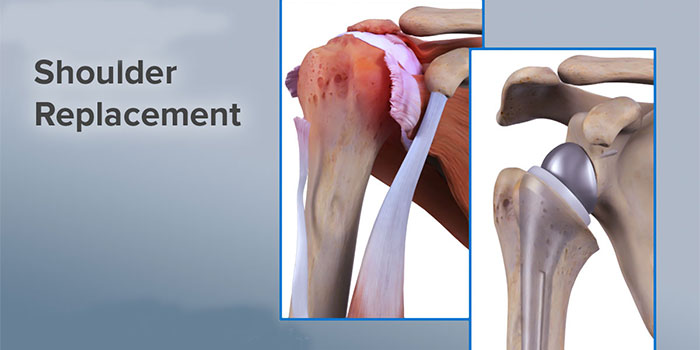
The typical total shoulder replacement involves replacing the arthritic joint surfaces with a highly polished metal ball attached to a stem, and a plastic socket.
These components come in various sizes. They may be either cemented or “press fit” into the bone. If the bone is of good quality, your surgeon may choose to use a non-cemented (press-fit) humeral component. If the bone is soft, the humeral component may be implanted with bone cement. In most cases, an all-plastic glenoid (socket) component is implanted with bone cement.
A reverse shoulder replacement is a design in which the positions of the ball and socket are switched: A metal ball implant is placed where the patient’s own natural socket was, and a plastic socket implant is placed on the head of the humeral head.
This reverse design has more stability and does not need the tendons to hold it in place. It’s motion is controlled by the deltoid muscle rather than the rotator cuff tendon. This make it an ideal choice when the damaged shoulder needs new surfaces, but does not have sufficiently healthy soft tissues to support stabilization and movement. It is commonly performed on patients who have shoulder arthritis and a severer rotator cuff tear.
Depending on the condition of your shoulder, your surgeon may replace only the ball. This procedure is called a hemiarthroplasty.
Some surgeons recommend hemiarthroplasty when the humeral head is severely fractured but the socket is normal. Other indications for a hemiarthroplasty include:
Sometimes, surgeons make the decision between a total shoulder replacement and a hemiarthroplasty in the operating room at the time of the surgery.
Resurfacing hemiarthroplasty involves replacing just the joint surface of the humeral head with a cap-like prosthesis without a stem. With its bone preserving advantage, it offers those with arthritis of the shoulder an alternative to the standard stemmed shoulder replacement.
For patients who are young or very active, resurfacing hemiarthroplasty avoids the risks of component wear and loosening that may occur with conventional total shoulder replacements in this patient population. Due to its more conservative nature, resurfacing hemiarthroplasty may be easier to convert to total shoulder replacement, if necessary at a later time.
This procedure to replace your shoulder joint with an artificial device usually takes about 2 hours.
Your surgeon will make an incision either on the front or the top of your shoulder. He or she will remove the damaged bone and then position the new components to restore function to your shoulder.
After surgery, your medical team will give you several doses of antibiotics to reduce your risk for infection, and pain medication to keep you comfortable. Most patients are able to eat solid food and get out of bed the day after surgery. You will most likely be able to go home on the second or third day after surgery.
When you leave the hospital, your arm will be in a sling. Your surgeon may instruct you to do gentle range of motion exercises to increase your mobility and endurance. A formal physical therapy program may also be recommended to strengthen your shoulder and improve flexibility.
You should be able to eat, dress, and groom yourself within a few weeks after surgery. Your surgeon may ask you to return for office visits and x-rays in order to monitor your shoulder.
Copyright © All Rights Reserved By Dr Rahul Khot.